


Find a store near you or order easily through our online store!

Natural horse feed

With Vitalbix Horse Feed, you can feed your horse in a way that aligns with its natural eating habits. Vitalbix Horse Feed is rich in fiber and contains no added sugars (molasses), whole grains, or soy. As a result, Vitalbix Horse Feed is very low in starch and sugar and is highly digestible.

Because Vitalbix contains a high concentration of vitamins and minerals, you can feed significantly less of it than regular horse feed.

Easily put together a healthy meal plan with our step-by-step guide!

Do you find it difficult to put together a healthy, balanced diet for your horse or pony, or are you feeling overwhelmed by all the options? No worries…

With our step-by-step guide, you can easily put together a healthy diet that’s fully tailored to your horse’s specific needs. And if you still have questions after following our guide, our nutrition experts will be happy to provide you with free, personalized advice.
Step 1 – Check your roughage management

Roughage is the foundation

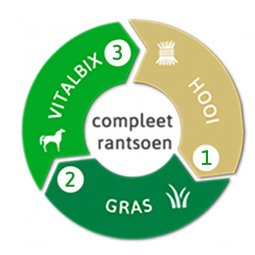
The foundation of a healthy diet consists of high-quality forage. By forage, we mean hay, haylage, and grass. Forage provides fiber that keeps your horse’s stomach and intestines healthy.

To keep your horse healthy, it’s important to tailor your forage management to your horse’s specific needs. A cool-blooded horse uses its energy more efficiently and generally needs less forage than a warm-blooded horse.

Check if your horse is at a healthy weight

Proper roughage management is essential for maintaining a healthy weight. And a healthy weight is the foundation of a healthy horse! To put together an optimal diet, it is therefore important to first assess whether your horse is at a healthy weight.

Great! The right amount of roughage is the foundation of a healthy weight. If your horse is at a healthy weight, you’re feeding the right amount of roughage. Spread the roughage out as much as possible throughout the day and night. To keep your horse’s stomach and intestines healthy, it’s important that your horse doesn’t go more than 6 hours without roughage.

Try to determine why your horse is underweight. Being underweight can be caused by insufficient roughage, but health issues such as a worm infestation or stomach ulcers may also be a factor. First, review your roughage management. If that’s in order but your horse is still underweight, contact your veterinarian to determine the cause.

Check out forage management
Not sure exactly how much hay your horse is getting each day? Try weighing the hay portions using a hay net and a weighing hook. As long as your horse is too thin, it’s best to give him unlimited roughage (give enough so there’s always some left over and your horse never runs out). Is unlimited hay feeding not possible in the stable? Then make sure your horse gets at least about 2 kg of hay per 100 kg of body weight per day—that’s 10 kg for a 500 kg horse. Is the roughage relatively low in nutrients? Then it may be necessary to increase the amount to about 15 kg per day for a 500 kg horse.

Generally speaking, coarser, long-stemmed hay is less nutritious, while finer hay is more nutritious. For a horse that is too thin, a finer type of hay or baled hay is usually the best choice. However, this isn’t always the case, so if you want to be sure you’re feeding the right type of forage, have it analyzed!

Fresh grass is ideal for helping horses gain weight. Does your stable have a suitable pasture? Then let your horse enjoy some time in the pasture! Of course, be sure to gradually increase the number of hours spent in the pasture to prevent digestive and metabolic issues.

Feed your horse preferably high-quality hay or haylage with a low energy content. Weigh the amount of forage using a hay net and a weighing hook, and reduce the daily amount of forage by about 10%.

As a guideline, you can aim for approximately 1.2% of the horse’s body weight in dry matter (the minimum is 1%). For a 500-kg horse, that amounts to 6 kg of dry matter per day. This means you can feed a 500-kg horse approximately 7 kg of hay and approximately 9 kg of haylage per day. Divide the roughage into as many portions as possible and ensure that your horse is not without hay for more than 4–6 hours.

Limit the number of hours your horse spends in the pasture and prevent it from gaining too much weight during the summer months. Fresh grass is highly energy-dense. Use a grazing mask to limit the amount of forage your horse consumes per hour while in the pasture, and feed hay in a slow feeder. If your horse is in the pasture, do not feed hay, or feed only a limited amount.

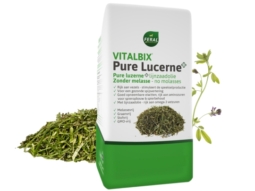
Are you planning to reduce the amount of roughage? If so, you’ll also be lowering the protein content of the diet. A protein deficiency can lead to muscle loss instead of fat loss. Therefore, replace 0.5–1.5 kg of hay with Vitalbix Pure Lucerne+ to provide extra protein (amino acids) and prevent muscle loss.

Give your horse all the nutrients it needs with Vitalbix Daily Complete Balancer!

It’s important for your horse to return to a healthy weight to prevent health problems such as laminitis!

Check out the forage management guide
What does the forage look like, and exactly how much does your horse get each day? Not sure? If so, we recommend having the forage analyzed and weighing the amount using a hay net and a weighing hook.

It is best to feed your horse high-quality hay or haylage with a low energy content. If necessary, you can replace some of the hay with grass seed hay or straw. Feed no more than 2 kg of this per day (for a 500 kg horse) to prevent colic.

It is best not to put your horse out to pasture (anymore) until it has regained a healthy weight. Fresh grass is high in energy.

Feed approximately 1.2% of the horse’s body weight in dry matter (the minimum is 1%). For a 500-kg horse, that amounts to 6 kg of dry matter. Feed approximately 7 kg of hay and approximately 9 kg of haylage per day. The exact amount you should feed depends on the nutritional value of the forage.

Are you planning to reduce the amount of roughage? If so, you’ll also be lowering the protein content of the diet. A protein deficiency can lead to muscle loss instead of fat loss. Therefore, replace 0.5–1.5 kg of hay with Vitalbix Pure Lucerne+ to provide extra protein (amino acids) and prevent muscle loss.

Provide your horse with all the necessary nutrients using Vitalbix Daily Complete Balancer.

And, of course, don't forget to give your horse plenty of exercise!

By regularly (at least once a week) taking a close look and feeling your horse, you can better assess whether your horse is at a healthy weight. A good indicator of a healthy weight is the fat on the ribs. First, look at your horse from about 2 meters away. Can you easily see the ribs? If so, your horse is too thin in the ribs.

Can’t see the ribs? Then run your thumb along the ribs from front to back, applying a little pressure as you go. At a healthy weight, you can’t see the ribs but can easily feel them. Do you have to press hard with your thumb to feel the ribs? Then your horse probably has a little too much fat on its ribs. Can’t you feel the ribs at all with your thumb? Then your horse really has too much fat on its ribs!

Just like humans, horses also have specific areas where they tend to store fat first. You may be able to easily feel your horse’s ribs, but your horse might be storing too much fat just behind the shoulder (the area under the saddle), on the neck, or on the hindquarters. Be sure to check these areas as well!

Still unsure after the assessment?
Then request a free nutrition consultation using the request form. You can attach a few (recent & clear) photos so we can help you with the assessment!

Step 2 – Vitamins & Minerals

This way, your horse will have everything it needs!

Roughage alone does not provide your horse with all the nutrients it needs to stay healthy. A deficiency in essential nutrients can have a significant impact on your horse’s health in the long term. It is therefore wise to always supplement roughage with additional vitamins and minerals.

Option 1: Supplement all essential nutrients with Vitalbix Daily Complete – the most concentrated formula

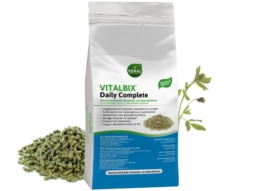
By supplementing your horse’s roughage with Vitalbix Daily Complete, you can be sure your horse is getting everything it needs. Vitalbix Daily Complete is a complete feed supplement with a balanced content of vitamins, minerals, and amino acids. The pellets are very low in starch and sugar and have a low calorie content. And, it is so concentrated that you only need to feed about 300 grams per day to a 500 kg horse! This means you can safely feed Vitalbix Daily Complete to horses that are overweight or prone to weight gain. Do you prefer an alfalfa-free option? Then check out the Daily Complete Timothy variety.

Option 2: Get all your essential nutrients with Vitalbix Balance+ Muesli – complete convenience

Would you rather give muesli?

By supplementing roughage with Balance+ Muesli, you still get all the benefits of a concentrated, complete feed—but with some added extras: pre-mixed soluble fiber, amino acids, B vitamins, and more. You feed a slightly larger amount: 600 grams for a 500-kg horse. That’s still far less than the amount of traditional muesli you’d need to feed to get enough vitamins and minerals. The muesli is alfalfa-, GMO soy-, and grain-free, contains no added sugars, and—according to thousands of horses—tastes great!

Step 3 – Add extra fiber

Encourage chewing

Mix Vitalbix Daily Complete pellets with some Vitalbix Fiber-Mix+ for extra fiber. The high-fiber texture encourages chewing and saliva production. This helps prevent your horse from eating too quickly and supports healthy gut flora. Just a handful is enough to encourage chewing.

Is your horse a bit underweight and could he use a little extra? If so, increase the amount of Vitalbix Fiber-Mix to, for example, 1 to 3 kg per day.

Thanks to its soft, shorter texture, Vitalbix Fiber-Mix is also easy to digest for horses with poor dentition. Is your horse having trouble chewing hay properly? If so, replace some of the hay with Vitalbix Fiber-Mix.

Step 4 – Add extra protein as needed

Is your horse lagging behind in muscle development?

Some horses need extra protein. Do you have a young horse that’s lagging behind in muscle development, is your sport horse (despite proper training) lagging behind in muscle development, or is your horse getting a bit older and do you want to prevent muscle loss? Then it’s helpful to supplement their diet with extra protein. You can easily add protein and fiber to the diet with Vitalbix Pure Lucerne+. Feed 0.5 to 2 kg of alfalfa per day as needed. Vitalbix Pure Lucerne+ contains a high proportion of easily digestible protein and supports muscle development. Alfalfa is also rich in fiber and encourages chewing.

Step 5 – Add extra energy as needed

Are you missing that little bit of extra power?

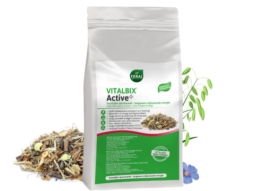
Do you feel your horse is lacking energy while riding and want to provide an extra energy boost? Then supplement Vitalbix Daily Complete with Vitalbix Active+ high-fiber sports muesli. Vitalbix Active+ is rich in fiber and low in starch and sugar. It gives your horse extra power in the form of sustained energy from fiber and fats, allowing your horse to perform at a steady, consistent level for longer periods!

Easily add extra energy

Vitalbix Active+ muesli also contains Vitalbix Daily Complete Balancer pellets (24%). This makes it easy to combine the products.

Example: If you add 500 grams of Vitalbix Active+ muesli, you are effectively adding (500 grams × 24%) 120 grams of Vitalbix Daily Complete kibble. You can subtract these 120 grams from the normal serving size of Vitalbix Daily Complete. If you normally feed 350 grams of Vitalbix Daily Complete per day, then with this combination you should feed 230 grams (350 grams – 120 grams) of Vitalbix Daily Complete plus 500 grams of Active+ muesli per day.

Step 6 – Omega-3 fatty acids

Does your horse spend less than 6 hours in the pasture?

Fresh grass contains a small amount of fat, but the fat it does contain consists mainly of omega-3 fatty acids (primarily ALA). Since horses have evolved as grazers, they are adapted to a diet rich in omega-3 fatty acids. When grass is dried into hay, most of these omega fatty acids—as well as vitamin E—are lost. Does your horse spend less than 6 hours a day in the pasture? Then it’s a good idea to supplement these fatty acids with Vitalbix Linseed Oil + Vitamin E!

Give Vitalbix Linseed Oil + Vitamin E daily or as a course of treatment

Vitalbix Linseed Oil + Vitamin E contains approximately 58% omega-3 fatty acids and can be fed daily, but you can also give it as a 4- to 12-week course of treatment when your horse needs a little extra support—for example, during the shedding season, when its immune system is compromised, or when it has summer eczema.

Step 7 – Healthy Slobber

Would you like to give your horse a little something extra?

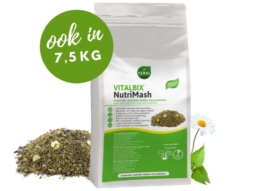
Then give your dog a serving of Vitalbix NutriMash high-fiber mash daily or a few times a week. It’s not only tasty but also very healthy! This mash contains a high proportion of prebiotic fiber that supports healthy gut flora, as well as extra B vitamins and a healthy blend of nettle, fennel seed, and chamomile.

Super tasty & healthy

Vitalbix NutriMash is highly palatable, can be soaked in cold or warm water, and is ready in just 5 minutes! Feed Vitalbix NutriMash as needed. For example, give 200–400 grams as a healthy treat after riding, or increase the amount to 0.5 to 2 kg per day if your horse is underweight or could use a little extra nutrition temporarily.

Step 8 – Preventive Care

Prevention is better than cure!

Whether your horse is in a sand paddock or out in the pasture, it often ends up ingesting more sand than is desirable. This is due to soggy pastures, searching for something edible in the sand, looking for bits of hay or grass roots in the paddock, boredom, drinking from puddles, etc. This sand is a real silent killer…it can build up over time until your horse suddenly develops colic.

The sand treatment that really works!

That’s why here at Vitalbix, we give all our horses a monthly preventive treatment, especially during the transitional months and in the winter. In the summer, every other month is fine too. Psyllium Mash tastes great, contains top-quality psyllium, and is easy to administer.

Are you still unsure about the ration?

Is your horse still too heavy or too thin? Is he prone to laminitis, or does he lack energy? Are you unsure about exactly how much to feed him or how to switch to Vitalbix? Our nutrition experts are happy to help you with all your nutrition questions!