Find a store near you or order easily through our online store!






Who wouldn’t want a beautiful, well-muscled horse? Especially when you’re training hard with your horse, it’s great to see results. Do you feel your horse isn’t muscular enough? Then read on for our tips!
First and foremost, it’s important to emphasize that training is the foundation of muscle development: if you don’t train your horse enough or don’t train it properly, muscle development won’t happen. But nutrition also plays a very important role. If your horse isn’t getting all the necessary nutrients from its diet, its muscle development may lag behind, even with proper training.
Tip 1: These nutrients are important for muscle growth!
As mentioned above, in addition to proper training, your horse needs the right nutrients to build muscle. The right balance of vitamins and minerals is important, but the most important nutrients for your horse’s muscle development are proteins and amino acids. If the diet contains too little protein, muscle growth is not possible and muscle breakdown may even occur. Forage provides the majority of the nutrients, and you can supplement this with additional feed such as Vitalbix.
What are amino acids?
Proteins are made up of amino acids. There are two types of amino acids: essential and non-essential amino acids. Your horse must obtain essential amino acids through its diet, as it cannot produce them on its own. Non-essential amino acids can be produced by your horse’s body and therefore play a less important role in its diet. A deficiency in essential amino acids such as lysine, methionine, cystine, threonine, and tryptophan is common, so it is wise to supplement these through additional feed. Regular concentrate feed often contains insufficient or no amino acids. At Vitalbix, we choose to add more than enough amino acids.
Tip 2: How to tell if your horse is getting enough protein
Forage is the primary source of protein and is therefore essential for your horse’s muscle development. Is your horse lagging behind in muscle development? If so, we recommend first having the forage analyzed for protein content and also weighing how many kilograms of hay your horse eats each day. Make sure you have the roughage analyzed not only for crude protein content but also for VREp content (digestible crude protein for horses). This is because a horse can only digest a portion of the proteins, which is why the VREp content is always used in calculations. So, if you have the VREp content and know how many kilograms of hay your horse eats per day, you’ll know approximately how much VREp your horse is consuming. Next, it’s important to calculate your horse’s nutritional needs—we use the CVB guidelines (Horse Nutrition Tables) for this. Not sure where to start? Request a free nutritional consultation and send us the forage analysis with the VREp content; we’d be happy to calculate it for you!
Insufficient protein from roughage
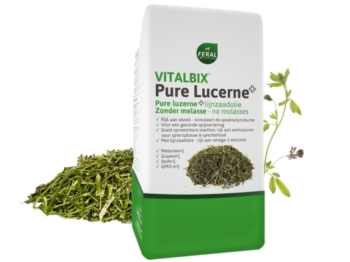
Once you’ve done the math, you may find that your horse isn’t getting enough protein from its forage. Depending on how much protein your horse is lacking and what its weight is, you can choose to increase the amount of forage or supplement it with a high-protein product. Alfalfa is an example of a product that is highly suitable for supplementing extra protein, as it contains a high digestible protein content. Also, be sure to compare the VREp content. This can vary by product type because sometimes the protein-rich leaves are sifted out, or alfalfa is mixed with another type of grass. Vitalbix Pure Lucerne+ is pure alfalfa, free of molasses or other unnecessary additives, with highly digestible protein. Is it difficult to analyze the roughage because it changes constantly? A good indicator is also how the rest of the horses in the stable look. Are there more horses whose muscle development is lagging behind? Then there is a good chance that the roughage is low in protein. Supplementing with Vitalbix Pure Lucerne+ can then be an excellent solution.
Increased need for protein
It’s also important to remember that nutritional needs can vary significantly from horse to horse. The heavier the workload, the higher the protein requirement. Young horses and pregnant or lactating mares also have increased protein needs. For a lactating mare, as well as for a horse involved in high-level competition, this can be up to 2–3 times higher than the requirement of a horse with little or no work. Feeding according to need is therefore important here as well.
Do you have any idea how much protein your horse consumes in a day—and how much protein your horse actually needs?
Tip 3: Summer vs. Winter
Fresh grass is high in protein, which is why horses often have better muscle tone in the summer. However, it’s also important to remember that horses tend to be a bit heavier in the summer. As a result, it’s often not until winter that you notice horses are lacking muscle tone, simply because they have less body fat during that season. So sometimes, appearances can be deceiving in the summer!
A healthy weight is crucial!
It’s difficult to assess muscle condition in horses that are overweight. But it’s also difficult to build muscle in horses that are too thin. In the winter, horses get fewer nutrients from the grass (or often none at all) and rely on hay or haylage. As a result, you often see horses losing weight. Therefore, carefully adjust the amount of roughage for your horse during the winter. By ensuring your horse is at exactly the right weight, you can better support him and help him become a true bodybuilder. Does your horse lose muscle mass during the winter months? Then take a close look at your roughage management, weigh the hay, and increase the daily amount of hay if necessary.
Haven't finished reading yet? Tip 4: Be sure to check out our blog post on the role of vitamins and minerals in building muscle.