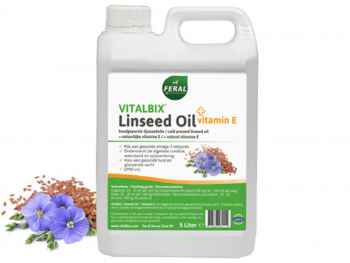




Is your horse not allowed in the pasture, or is its access restricted?
In that case, supplementing with omega-3 fatty acids is essential to keeping your horse healthy.
In that case, supplementing with omega-3 fatty acids is essential to keeping your horse healthy.
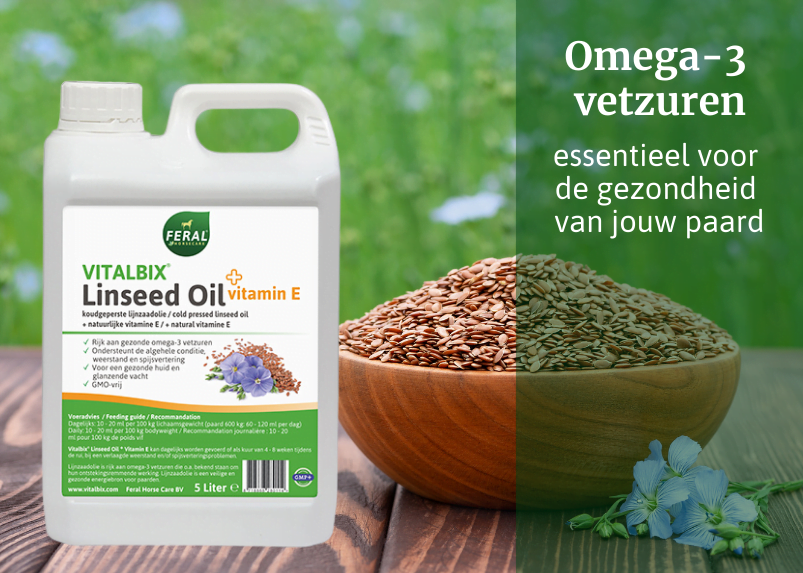
These fatty acids play an important role in many bodily processes, such as:
Does your horse have little or no access to pasture—simply because there isn’t much grassland at your stable, or because your horse gains weight just by looking at grass? If so, he can quickly develop a deficiency in these healthy fats. We’d be happy to explain exactly how this works.
– Fresh grass contains approximately 4% fat per kilogram of dry matter (this varies depending on the type of grass, growth stage, weather, etc., but averages around 4%)
– This fat is rich in omega fatty acids, of which approximately 50 to 75% are omega-3 fatty acids (ALA)
– Omega fatty acids are important for many processes in the body and are essential. This means that your horse cannot produce these fatty acids on its own but must obtain them through its diet
– A deficiency in these fatty acids can contribute to conditions such as allergies (e.g., summer eczema), reduced immunity, poor hoof quality, or slower recovery after training
– These fatty acids are also essential for the absorption of fat-soluble vitamins such as vitamins A, D, E, and K
As you can see, these fatty acids are essential for keeping your horse healthy! If your horse isn’t out in the pasture—or is only out for a few hours—it’s a good idea to supplement its diet with extra omega fatty acids.
Why supplement with Vitalbix Linseed Oil + Vitamin E?
At Vitalbix, we recommend supplementing these fatty acids in your horse’s diet with flaxseed oil, such as Vitalbix Linseed Oil + Vitamin E. Why? Because the fatty acid profile of flaxseed (oil) most closely matches that of grass and other plants your horse would eat in the wild, with a high proportion of omega-3 (ALA) and a lower proportion of omega-6 (LA). By adding Vitamin E, a powerful antioxidant, we ensure that the quality of the cold-pressed oil is preserved.
What about omega fatty acids in products like salmon oil?
Salmon oil also contains a high proportion of omega-3 fatty acids, but in a different form—primarily EPA and DHA rather than ALA. These fatty acids are more easily absorbed by humans. The body does not first need to convert ALA into EPA and DHA itself. It is claimed that this is also better for horses, but horses are not humans—and have you ever seen a horse eating salmon in the wild? Horses process omega-3 fatty acids very differently from humans because they are naturally accustomed to obtaining them through their diet (natural vegetation), primarily in the form of ALA.
Exactly how much oil should you add?
That’s probably a bit more than most horse owners realize.
Here comes the math…!
Fresh grass contains 15–20% dry matter. This means that the rest, approximately 80–85%, consists of water. A horse can consume 2% of its body weight in dry matter per 24 hours. Depending on the quality of the grass and the horse’s needs. For a 500-kg horse, this amounts to 10 kg of dry matter per day. This means that a 500-kg horse can consume a maximum of 50 to 65 kg of fresh grass per 24 hours. In practice, this will likely be slightly less, but if your horse is out in the pasture for only a few hours a day, it will graze almost constantly. On average grassland, a large horse consumes about 4–5 kg per hour. For a pony, this is approximately 2.5–3.5 kg of fresh grass per hour.
If your horse spends 6 hours in the pasture, it will eat approximately 24 to 30 kg of grass.
With a dry matter content of 15% and 4% fat, this means it consumes 145 to 180 grams of fat, a high proportion of which consists of omega-3 fatty acids. Hay has a significantly lower fat content of about 2% per kg of dry matter. A large portion of the healthy omega fatty acids is lost as soon as grass is dried into hay, and the content of healthy omega-3 fatty acids in particular decreases rapidly!
Does your horse spend 4 to 6 hours a day in the pasture?
If so, supplement with 10 to 20 ml of Vitalbix Linseed Oil + Vitamin E per 100 kg of body weight, which amounts to 50 to 100 ml per day for a 500 kg horse
Is your horse not out in the pasture at all?
Ideally, supplement with 25 to 30 ml of Vitalbix Linseed Oil + Vitamin E per 100 kg of body weight; that is approximately 125 to 150 ml of oil for a 500 kg horse.
Vitalbix Daily Complete, Active+, Breed & Grow, and NutriMash also contain approximately 10% flaxseed (which equates to about 40 ml of oil per kg of feed); therefore, if you feed 1 kg of Vitalbix Active+, you can subtract 40 ml of oil from the recommendation above.
Is your horse overweight?
Oil is high in calories! Therefore, feed a maximum of 10 ml per 100 kg of body weight per day (50 ml per day for a 500-kg horse).
Would you like to use oil as an additional energy source?
In that case, you can increase the amount of oil to about 300 ml per day for a horse weighing 500 to 600 kg. Be sure to always increase the dosage gradually! Is your horse experiencing loose stools? If so, you’ve increased the amount too quickly and should reduce it slightly.
Most horses enjoy a little oil mixed into their feed. Is your horse not a big fan? In that case, you can mix the oil into some Vitalbix NutriMash, for example. Your horse won’t even notice it and will likely eat it up with gusto!
Flaxseed oil is a healthy addition to your horse’s diet, and as you’ve read above, there are several reasons to include it in their feed.
Here are the top 7 reasons to supplement with flaxseed oil!
1. For extra omega-3 fatty acids when grazing time is less than 6 hours per day
2. For extra energy (slow-release) to improve performance
3. For extra calories if your horse needs to gain weight
4. To support the immune system
5. For skin issues such as summer itch, dry skin, and a dull coat
6. To support digestion; combine with psyllium fiber and, together with the oil, help remove sand from the intestines
7. For inflammation and injuries; omega-3 fatty acids have anti-inflammatory properties and can aid in recovery
Want to know how much oil you should add to your dog’s diet? Request a free feeding consultation. Our experts are happy to help!
Want to learn more about the benefits of flaxseed oil compared to other types of oil? Then read this blog.

Every horse is unique and has different nutritional needs. That’s why our nutrition experts are happy to provide you with free, personalized nutrition advice to help you create the optimal diet for your horse(s). Do you have an overweight pony, a sport horse with a sensitive stomach, or multiple horses ranging from young to old? Our experts are happy to help you with all your nutrition questions. And with the nutrition advice form, requesting advice is very easy!